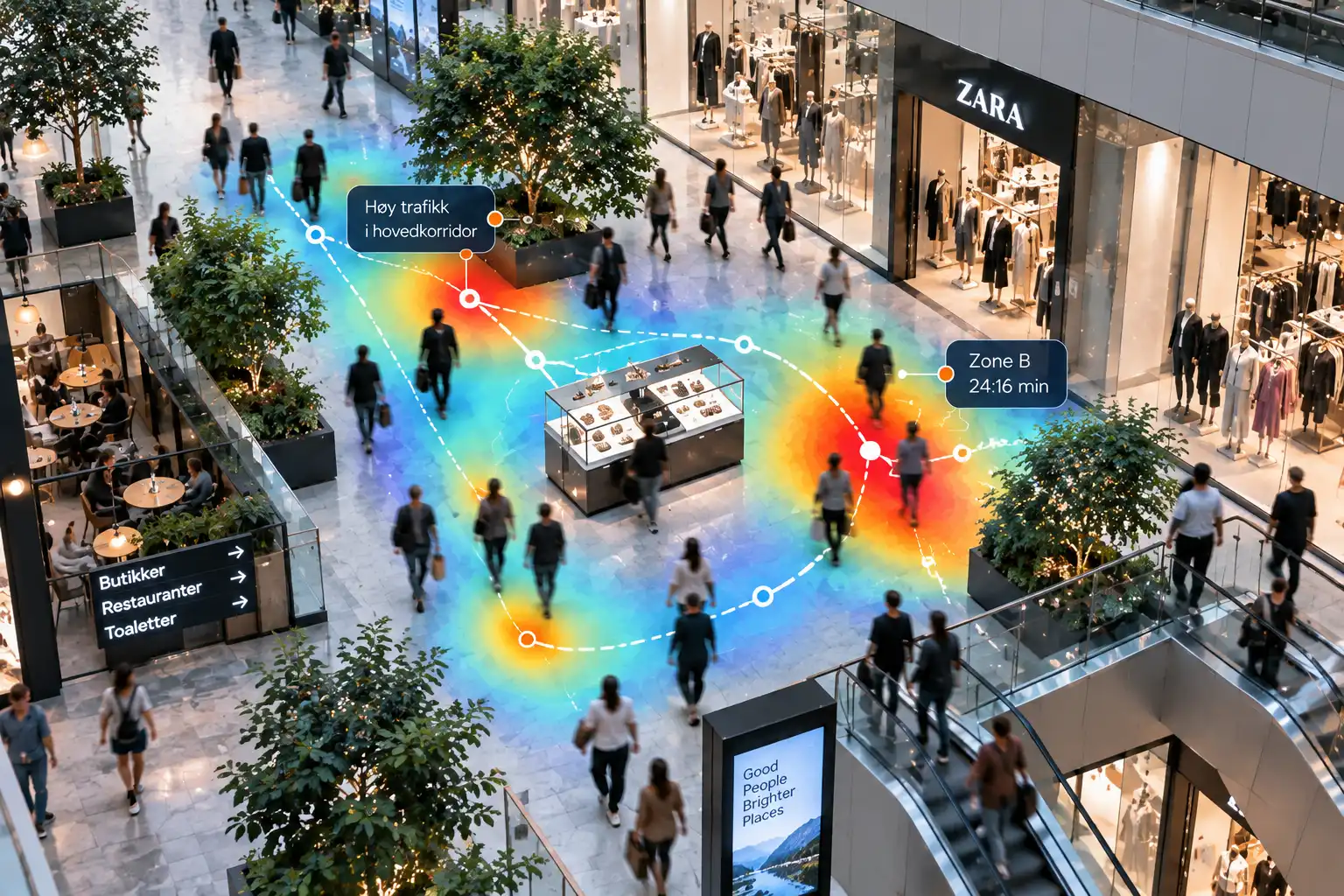

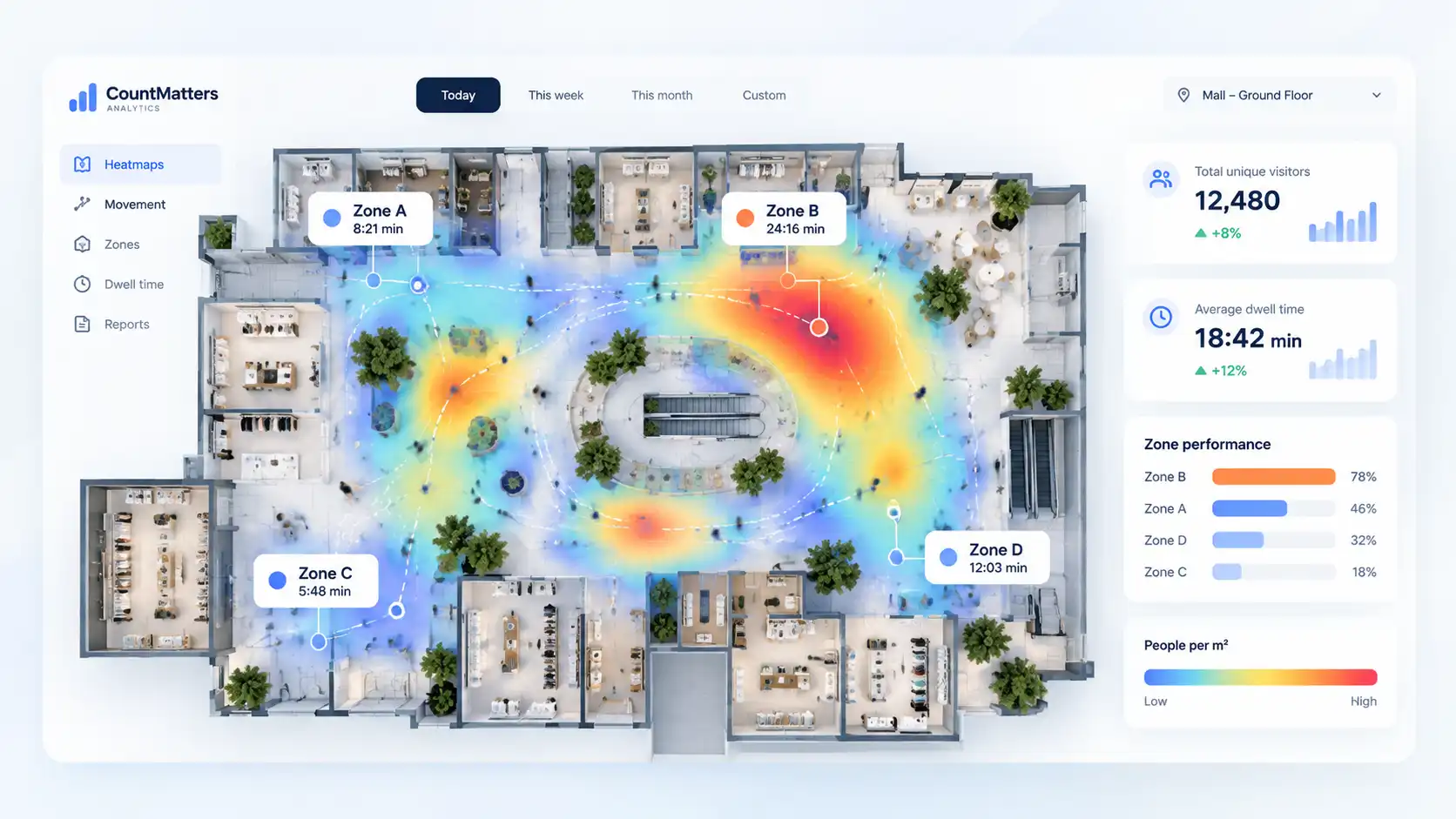
Aggregated movement patterns. Defined zones. Comparable over time.

HEATMAPS & MOVEMENT TRACKING

Hero Section - Heatmpas

Visualize how people move through physical spaces — across zones, floors, and defined pathways — to optimize layout, flow, and utilization.

DISCUSS YOUR SETUP


USE CASE

WHAT ARE HEATMAPS & MOVEMENT TRACKING?

Heatmaps visualize aggregated presence in defined areas. Movement tracking shows how traffic flows between zones — so teams can improve layout, flow, and space utilization.

  • Aggregated patterns
    Shows patterns and concentration over time — without identifying individuals.
  • Defined zones
    Measurement happens in documented areas that can be updated when layouts change.
  • Flow between areas
    Reveals main routes, bottlenecks, and underuse between entrances, corridors, and zones.
METRICS

WHAT IS MEASURED

The metrics below describe presence and movement in defined areas. Everything is aggregated as patterns — not personal data.

Zone presence

How much activity occurs in a defined area over time.

Used to identify underuse and hotspots.

Density / concentration

Distribution of presence within a zone — where it concentrates.

The basis for heatmaps.

Flow between zones

How traffic moves from one defined area to another.

Reveals main routes and alternatives.

Dwell concentration

Where activity accumulates over time — useful in stop-and-wait areas.

Signals friction or attractive zones.

Time profiles

How patterns change by hour, day, and week — for planning and comparison.

Makes changes measurable over time.
AUTHORITY

WHY MEASURING FLOW IS DIFFICULT

In real facilities, flow is rarely “clean.” Measurement must handle open areas, intersecting streams, and layout changes — while keeping results comparable.

  • Open layouts
    Without hard boundaries, traffic moves freely and overlaps zones.
  • Intersecting streams
    Movement often goes both directions at once, especially at choke points.
  • Change over time
    Refits, furniture changes, and temporary setups break comparability.
  • Multiple entrances and shortcuts
    Open passages and side entrances distort patterns unless zones are defined correctly.
  • Stop-and-go accumulation
    Queues and waiting create “hot” zones that must be interpreted correctly.
  • Benchmarking requirements
    Operations need standardized metrics across sites and time periods.
OUTCOMES

WHAT IT ENABLES

When flow and presence become measurable, improvements can be driven by data — not assumptions.

Layout optimization

Adjust functions and furniture based on real movement patterns.

  • Identify overloaded passages
  • Test changes and measure impact

Reduce bottlenecks

See where traffic accumulates and where flow breaks down.

  • Expose congestion at choke points
  • Prioritize changes where they matter

Improve wayfinding

Optimize signage and routes by understanding natural movement choices.

  • Reduce wrong-way flow and detours
  • Reroute traffic away from tight areas

Prioritize operations and cleaning

Plan resources based on actual zone usage and time-of-day patterns.

  • See which areas require attention
  • Shift effort from low to high use

Prove changes

Use before/after comparisons to document the impact of changes.

  • Measure impact by zone and period
  • Support decisions with comparable data

QUESTIONS & ANSWERS

Concise, operational, and verifiable — for teams evaluating method and deployment.

Transforming Visitor Data
into Business Success

For over 30 years, CountMatters has defined the standard in visitor analytics.
As the original innovators of people counting, we transform foot traffic into business intelligence.


700+
customers using our solutions
100k+
installations
 
30 Years+
Decades of actionable visitor insights.
 
Guaranteed Satisfaction
Your success is our goal


TALK TO US ABOUT HEATMAPS & MOVEMENT TRACKING

Learn how CountMatters delivers comparable, privacy-first flow insight across zones, floors, and locations — so layout and operational changes can be measured over time.