

RELIABLE MEASUREMENT IN PUBLIC SPACES

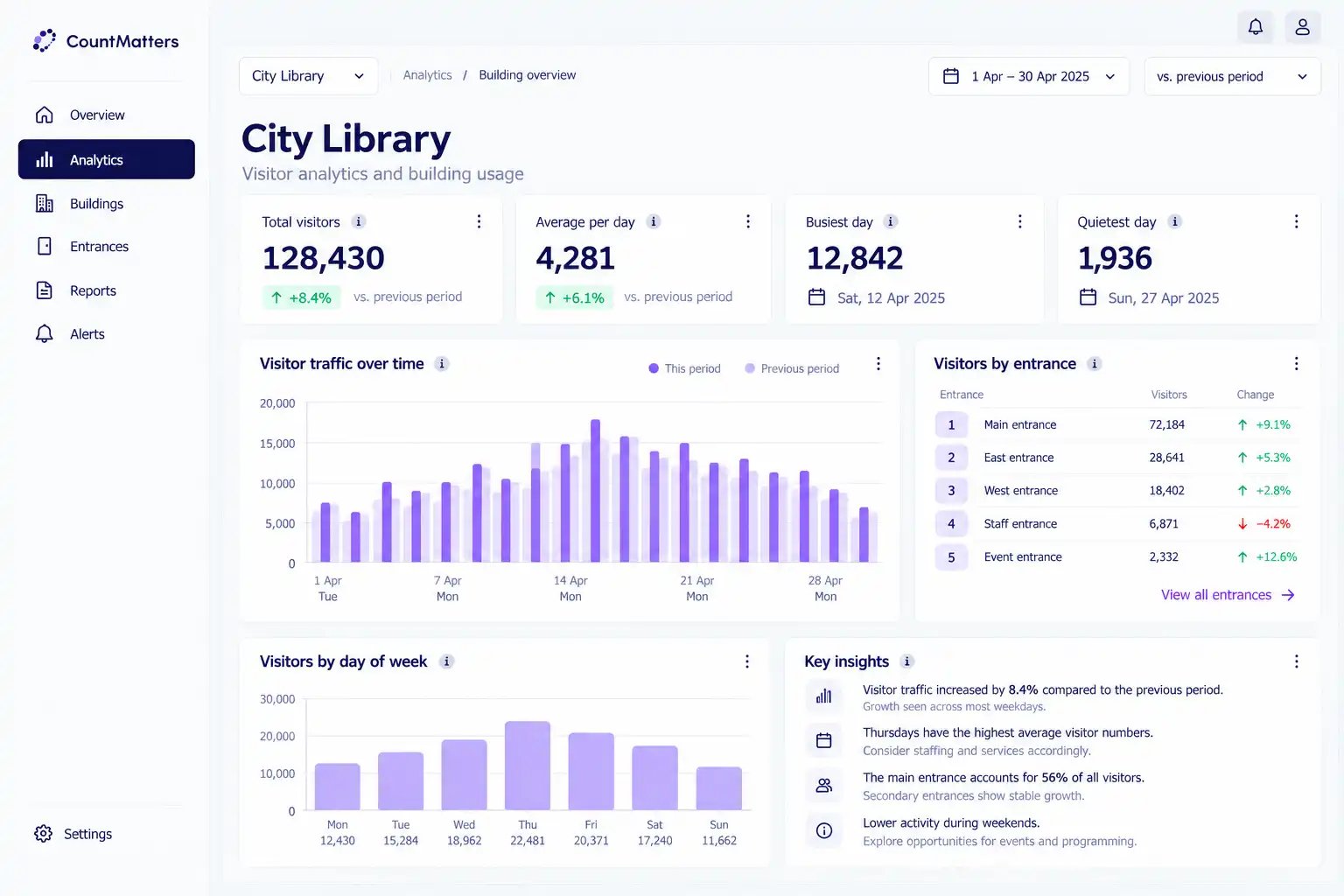
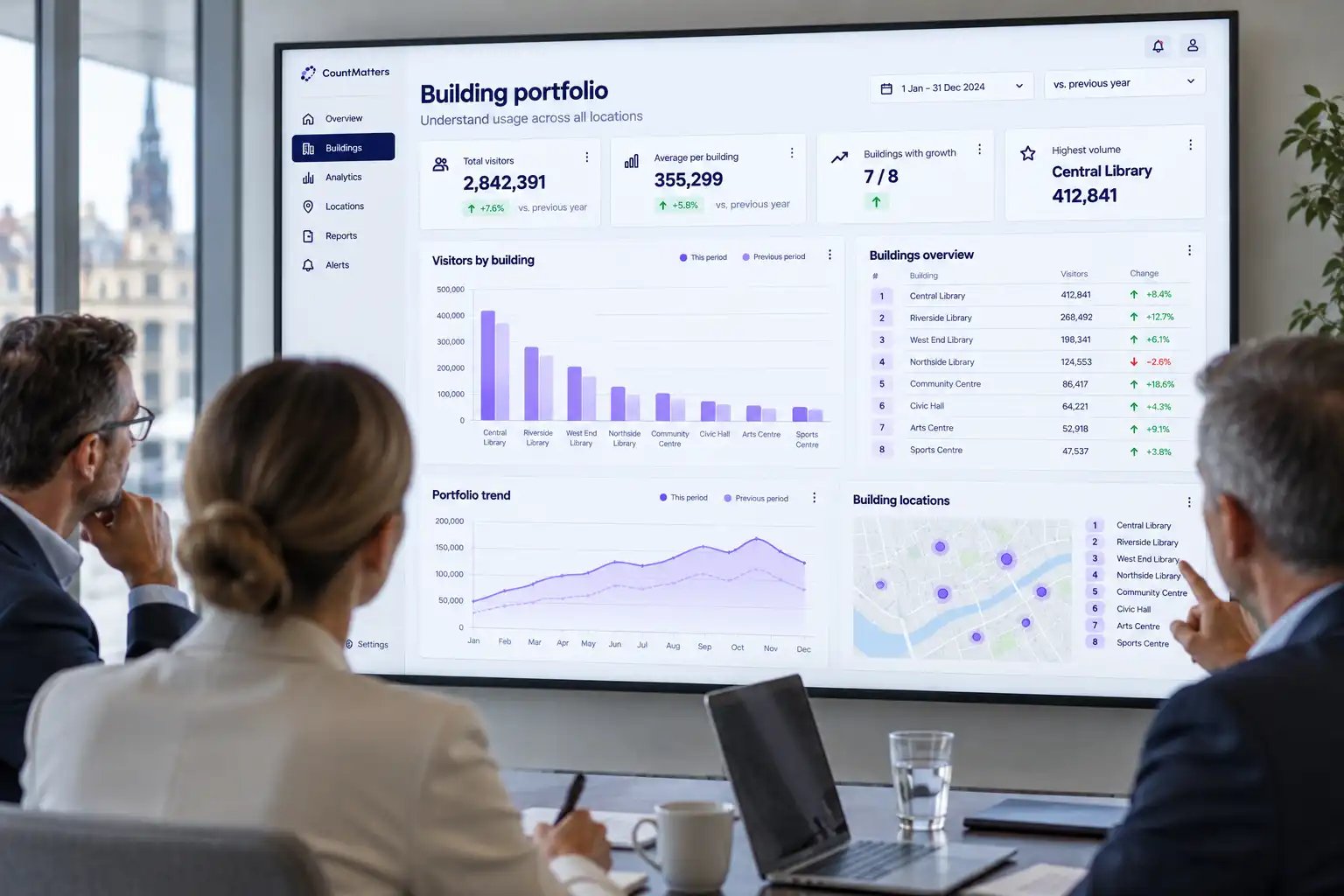
Measure movement, presence and occupancy across civic buildings, campuses and public facilities — where safety, accessibility and accountability matter.

SEE HOW MEASUREMENT WORKS

INDUSTRY: URBAN & PUBLIC SPACES

Why urban space measurement fails without structure

Movement data is fragmented across sources

Pedestrian, cycling, and vehicle flows are often measured separately — or not at all.

Without standardized methodology, municipalities lack a unified view of how people move through public areas.

Open environments lack clear boundaries

City centers, plazas, and parks rarely have defined entry and exit points.

Without calibrated measurement zones, raw counts do not represent actual presence or usage patterns.

Temporal variation distorts insight

Weather, tourism, events, and seasonal shifts create large fluctuations in public space usage.

Without structured baseline periods and historical normalization, long-term trends are difficult to interpret reliably.

Density and safety thresholds are reactive

Crowding conditions can escalate quickly during events or peak tourism periods.

Without predefined occupancy thresholds and monitoring frameworks, response becomes reactive rather than preventive.

Investment decisions lack comparable data

Urban development projects require evidence across time and locations.

Without standardized data collection and benchmarking rules, infrastructure investments rely on incomplete analysis.

Effective urban planning requires standardized measurement of movement, presence, density, and long-term trends.

METRIC LAYER

WHAT CAN BE MEASURED IN PUBLIC SPACES

Standardized measurement of pedestrian movement, presence, density, and infrastructure performance — comparable across zones and time periods.

PEDESTRIAN VOLUME

Verified counts of people entering defined areas or pathways.

FLOW PATTERNS

Directional movement between zones, streets, or public areas.

DWELL TIME

Measured time spent in defined public zones.

DENSITY LEVELS

Real-time concentration of people within defined areas.

QUEUE LENGTH & WAIT TIME

Measured waiting conditions at service points, ticket counters, or controlled access areas.

CAPACITY THRESHOLD BREACHES

Detected instances where predefined occupancy or density limits are exceeded.

PEAK LOAD PERIODS

Identified high-traffic intervals across day, week, or event cycles.

AREA UTILIZATION RATE

Actual use of defined zones relative to available capacity.

ZONE BENCHMARK INDEX

Normalized comparison across districts, facilities, or time periods.

How measurement works in public spaces

In public spaces, measurement must handle weather, seasonality, events, and open areas—while keeping definitions traceable and decisions defensible.

ZONES & OPEN AREAS

Open areas need clear boundaries and definitions for passing, dwelling, and direction—otherwise the numbers become political.

  • Defined lines for in/out and crossings
  • Separate throughflow vs dwell
  • Traceability when zones change

OUTDOOR ROBUSTNESS

Environmental conditions affect measurement. Deployment must be designed for weather, lighting, and maintenance without data breaks.

  • Stable mounting and defined field-of-view
  • Monitoring for uptime and connectivity
  • Maintenance plan without losing comparability

EVENTS & SEASONALITY

Public spaces are shaped by events and seasonality. Data must be segmentable to support the right decisions.

  • Event context for peaks
  • Like-for-like comparisons
  • Clear baseline vs anomalies

GOVERNANCE & DOCUMENTATION

When numbers drive prioritization and investments, methods, definitions, and changes must be documented and reviewable.

  • Clear ownership of definitions
  • Deviation handling and change log
  • Exports for internal controls and audits

TURN FOOT TRAFFIC INTO GROWTH

Trusted by public institutions for over 30 years, CountMatters turns visitor data into smarter decisions that improve safety, efficiency, and the visitor experience.
 

TALK TO US ABOUT RELIABLE MEASUREMENT IN PUBLIC SPACES

Learn how CountMatters supports consistent measurement across locations and over time.

 
Hero Section - Homepage